Data Pipeline & Approach
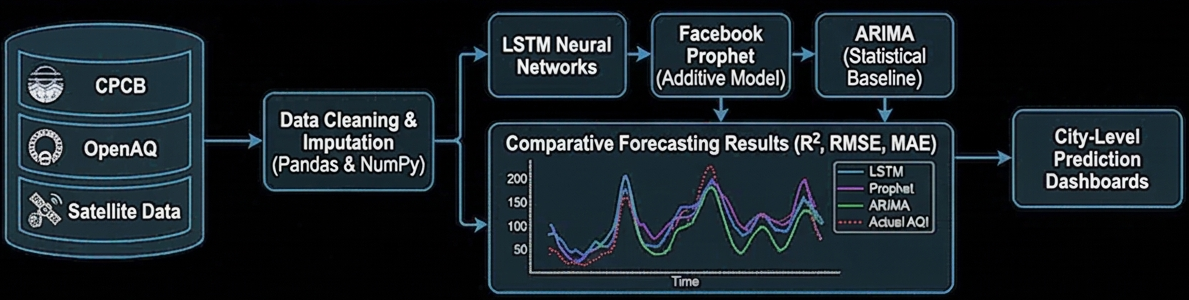
Building an accurate forecasting model required handling complex, noisy, real-world data from varied sources:
- Data Ingestion & Cleaning: Aggregated vast datasets directly from the Central Pollution Control Board (CPCB) and OpenAQ for major metropolitan areas including Delhi-NCR, Bangalore, Mumbai, and Varanasi.
- Target Metrics: Designed the pipeline to specifically target and predict critical air quality markers including aggregate AQI, PM2.5, and PM10 particulate matter.
- Model Architecture Comparison: Rather than relying on a single algorithm, I built
and scientifically compared three distinct forecasting paradigms:
1. LSTM Neural Networks: A deep learning approach capable of understanding long-term non-linear dependencies.
2. Facebook Prophet: A robust additive regression model highly effective with daily and yearly seasonality.
3. ARIMA: A classic statistical baseline for autoregressive integrated moving averages.