Architecture Approach
System Pipeline:
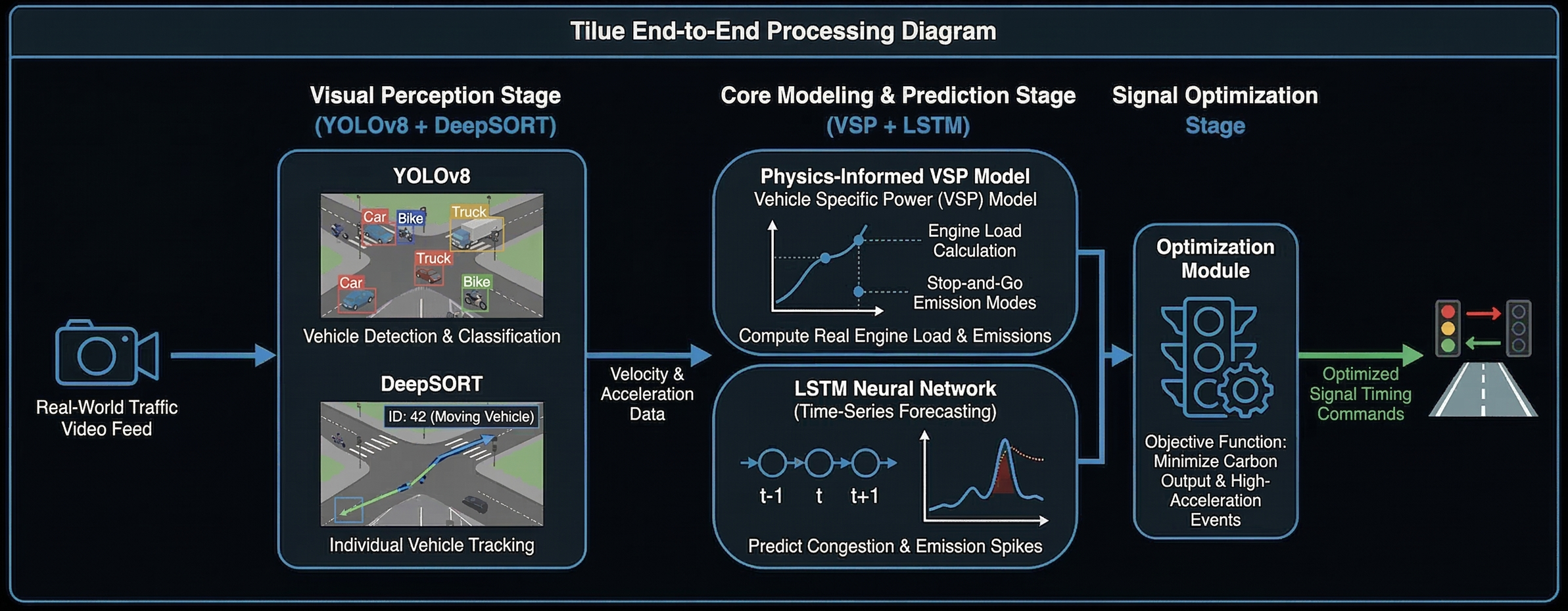
I engineered this solution as a complete, end-to-end pipeline processing real-world data feeds:
- Vehicle Detection: Deployed YOLOv8 to detect and classify different vehicle types directly from existing traffic video feeds, ensuring high accuracy frame-by-frame.
- Vehicle Tracking: Applied the DeepSORT tracking algorithm to follow each unique vehicle across frames. This step was critical to calculating accurate velocity and acceleration data for individual cars rather than generalizations.
- Emission Estimation: Instead of relying on a flawed generic average speed calculation, I implemented a physics-informed Vehicle Specific Power (VSP) model. This allowed the system to compute the real engine load and distinct emission operating modes for each vehicle.
- Predictive Modeling: Trained a multivariate LSTM (Long Short-Term Memory) neural network on the historical state data to predict near-future congestion patterns and upcoming emission spikes before they happen.
- Signal Optimization: Finally, an optimization module ingests the LSTM predictions and dynamically alters traffic signal timing. The objective function minimizes carbon output and reduces high-acceleration events rather than explicitly just minimizing wait time.